


Coordinate Measuring Machines: The Ultimate Guide to Precision Metrology
Coordinate Measuring Machines (CMM) have revolutionized the field of metrology and quality control. In an era where manufacturing tolerances are tighter than ever, the ability to verify the precise dimensions and geometric characteristics of a part is not just an advantage—it’s a necessity. Coordinate Measuring Machines (CMM) provide this capability with unparalleled accuracy and efficiency, serving as the backbone of quality assurance in industries ranging from aerospace and automotive to medical device manufacturing. This comprehensive guide will delve into what CMMs are, how they work, their different types, applications, and the profound benefits they bring to modern production environments.
What is a Coordinate Measuring Machine (CMM)?
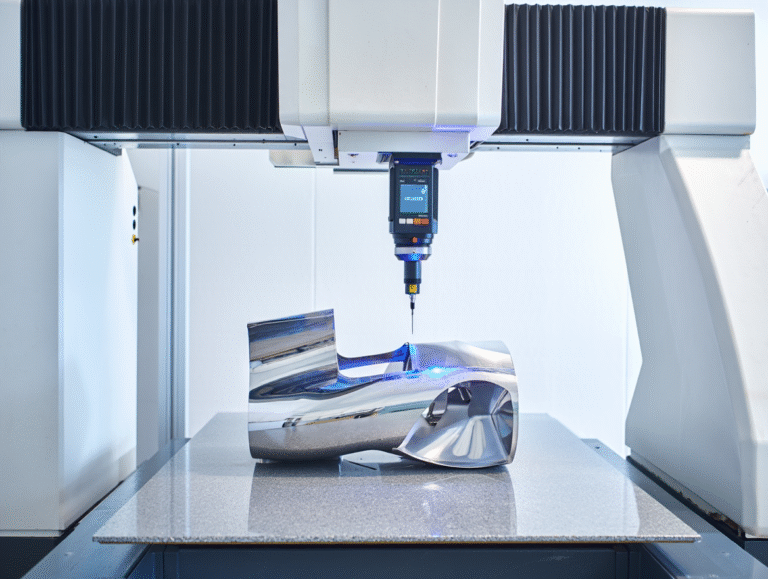
At its core, a Coordinate Measuring Machine (CMM) is a device for measuring the physical geometrical characteristics of an object. The machine does this by using a probing system to detect discrete points on the surface of a workpiece. These points are defined in a three-dimensional coordinate system (X, Y, and Z axes), which allows the CMM to precisely determine the position, size, form, and orientation of the part’s features.
A typical CMM consists of three main components:
1. Main Structure: This includes the bridge, gantry, or arm that moves the probe along the three orthogonal axes.
2. Probing System: This is the “finger” of the CMM that physically touches (or, in non-contact systems, senses) the part. The most common type is a touch-trigger probe.
3. Control and Computing System: This includes the software that controls the machine’s movements, captures the measurement data, and analyzes it against the original CAD model or design specifications.
How Does a Coordinate Measuring Machine Work?
The operation of a Coordinate Measuring Machine (CMM) can be broken down into a systematic process:
1. Part Placement: The workpiece to be measured is securely placed on the CMM’s granite table, known for its exceptional stability and flatness.
2. Probe Calibration: Before measurement begins, the probe is calibrated using a reference sphere of known diameter. This ensures that the machine understands the exact size and position of the probe tip, guaranteeing measurement accuracy.
3. Coordinate System Alignment: The operator defines the part’s coordinate system by measuring reference features on the part itself. This aligns the CMM’s coordinate system with the workpiece, ensuring that measurements are taken in the correct orientation as intended by the design.
4. Data Collection (Probing): The probe is moved along the X, Y, and Z axes to touch specific points on the part’s surface. Each touch records a point in 3D space with coordinates (X, Y, Z). Modern CMMs can collect hundreds or thousands of points in seconds.
5. Data Analysis: The CMM software then compares the collected point cloud data to the nominal CAD model or the design dimensions. It performs complex calculations to evaluate parameters like diameter, flatness, perpendicularity, position, and many other Geometric Dimensioning and Tolerancing (GD&T) characteristics.
6. Reporting: Finally, the software generates a detailed report, often in a graphical format, highlighting any deviations from the design specifications. This report is crucial for making informed decisions about the production process.

Types of Coordinate Measuring Machines
Coordinate Measuring Machines (CMM) come in various configurations, each suited to different applications, part sizes, and accuracy requirements.
1. Bridge CMM: This is the most common and traditional type. It offers high accuracy and rigidity, making it ideal for measuring small to medium-sized parts in a quality lab environment.
2. Gantry CMM: Designed for measuring very large and heavy parts, such as car bodies or aircraft wings. The structure is mounted on the floor, and the moving bridge travels over the stationary part.
3. Cantilever CMM: Features a single vertical column supporting the horizontal arm. They offer easy access from three sides but are generally less rigid than bridge types, making them suitable for smaller, lighter parts.
4. Horizontal Arm CMM: The probe is mounted on a long horizontal arm. These are excellent for measuring large, thin, or sheet-like parts, like car body panels.
5. Articulating Arm CMM: A portable, flexible alternative to traditional CMMs. It resembles a human arm with rotary joints and is ideal for measuring large objects in the field or on the shop floor where portability is key.
Furthermore, CMMs can be categorized by their probing technology
• Contact CMMs: Use physical touch-trigger or scanning probes.
• Non-Contact CMMs: Use optical, laser, or vision-based systems to capture surface data without physical contact. This is perfect for delicate, soft, or highly detailed surfaces.
Key Applications of Coordinate Measuring Machines
The versatility of Coordinate Measuring Machines (CMM) makes them indispensable across numerous sectors.
• First-Article Inspection: Verifying that the first part off the production line conforms to all design specifications before full-scale production begins.
• Dimensional Analysis: Precisely measuring lengths, diameters, angles, and other critical dimensions.
• Geometric Dimensioning and Tolerancing (GD&T) Analysis: Evaluating complex geometric characteristics like flatness, straightness, circularity, cylindricity, and true position.
• Reverse Engineering: By capturing a dense point cloud of an existing physical part, a CMM can help create a digital 3D CAD model.
• Tool and Fixture Validation: Ensuring that manufacturing tools, jigs, and fixtures are built correctly and have not worn out over time.
• Assembly Verification: Checking the alignment and fit between assembled components.
The Critical Benefits of Using a CMM
Integrating a Coordinate Measuring Machine (CMM) into a quality control process offers transformative advantages:
• Unmatched Accuracy and Precision: CMMs eliminate human error associated with manual measurement tools like calipers and micrometers, providing reliable, repeatable data.
• Dramatically Increased Speed: Automated CMMs can measure complex parts in minutes, a task that could take hours manually. This significantly boosts inspection throughput.
• Versatility: A single CMM can be programmed to measure a vast array of part geometries, from simple blocks to complex, sculpted surfaces.
• Comprehensive Data for SPC: CMMs generate rich datasets that can be fed into Statistical Process Control (SPC) systems, allowing manufacturers to identify trends, predict potential process failures, and implement corrective actions proactively.
• Reduced Scrap and Rework: By identifying non-conforming parts early in the production process, CMMs prevent the production of large batches of defective components, saving substantial time and money.
Common Errors in CMM Operation and How to Avoid Them
Despite their sophistication, the accuracy of a Coordinate Measuring Machine (CMM) can be compromised by several common errors. Understanding and mitigating these is crucial for reliable results.
1. Poor Probing Strategy: Using an insufficient number of points or poorly distributed points can lead to an inaccurate representation of a feature. For example, measuring a circle with only three points will not reveal its true roundness.
• Solution: Follow best practices for the number and distribution of points for each geometric feature. Use scanning probes for dense data capture on complex surfaces.
2. Incorrect Probe Calibration: A poorly calibrated probe is one of the largest sources of measurement error. The machine will not know the true position of the probe tip, leading to systematic inaccuracies.
• Solution: Always calibrate the probe with a qualified master artifact (like a reference sphere) before a measurement session, and recalibrate whenever the probe setup changes or the environment fluctuates.
3. Thermal Expansion: CMMs, probes, and parts are all susceptible to thermal expansion and contraction. A temperature change of just a few degrees can cause significant measurement drift, especially on large parts.
• Solution: Operate the CMM in a temperature-controlled environment (typically 20°C / 68°F). Allow parts to acclimate to the room temperature before measurement. Use materials with low coefficients of thermal expansion for the machine structure.
4. Inadequate Part Fixturing: If a part is not securely and repeatably fixtured, it can move during probing, ruining the measurement.
• Solution: Use dedicated, stable fixtures and clamps to hold the part firmly in place without causing distortion.
5. Software and Programming Errors: A perfectly measured part can be misjudged due to errors in the measurement program or incorrect data analysis settings in the software.
• Solution: Thoroughly validate and debug CMM programs. Ensure operators are well-trained in both the machine’s operation and the interpretation of GD&T standards within the software.
6. Neglecting Machine Maintenance: CMMs are precision instruments. Failure to perform regular maintenance, such as cleaning air bearings, checking for mechanical wear, and verifying accuracy, will lead to performance degradation.
• Solution: Adhere to a strict preventive maintenance schedule as recommended by the manufacturer. Regularly perform reverification tests using gauge blocks or step gauges.
The Future of Coordinate Measuring Machines
The evolution of Coordinate Measuring Machines (CMM) continues, driven by the demands of Industry 4.0. Key trends include:
• Integration with Automation: CMMs are increasingly being integrated into robotic cells and production lines for 100% in-process inspection, moving from the quality lab to the shop floor.
• Multi-Sensor Systems: The combination of touch probes, laser scanners, and vision systems on a single machine provides ultimate flexibility to measure any feature with the optimal technology.
• AI-Powered Software: Artificial intelligence is being used to optimize measurement paths, automatically recognize features, and provide deeper insights into production quality.
• Portable Metrology: The rise of ultra-portable CMMs, like advanced articulating arms and handheld laser scanners, is bringing high-accuracy measurement directly to the workpiece.
Conclusion
From ensuring the safety of an aircraft engine to guaranteeing the perfect fit of a consumer product, Coordinate Measuring Machines (CMM) are a foundational technology in modern engineering and manufacturing. They provide the critical data needed to control processes, reduce waste, and deliver high-quality products. As technology advances, CMMs are becoming faster, more versatile, and more integrated, solidifying their role as an indispensable tool in the relentless pursuit of precision and perfection. By understanding their operation, benefits, and potential pitfalls, manufacturers can fully leverage the power of CMMs to gain a decisive competitive edge.