


What is a Gauge Block Comparator?
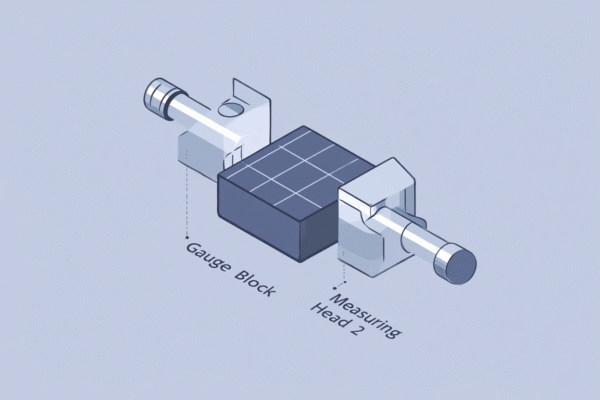
A Gauge Block Comparator is an inspection instrument designed specifically for checking the dimensional accuracy of gauge blocks (also known as slip gauges or jo blocks). It enables a calibration or metrology lab to compare a candidate gauge block’s length, flatness, parallelism, and other geometric tolerances against a reference standard. For example, the Mitutoyo GBCD-100A Automatic Gauge Block Comparator is described as a dual-head system that “automatically compares workpieces with a standard gauge block and determines accuracies such as central length, maximum length, minimum length, and parallelism.” (mitutoyo.co.th)
In essence, it raises the precision and throughput of gauge block calibration, by automating measurement tasks that would otherwise require manual comparator setups or interferometric methods.
Working Principle of the Gauge Block Comparator
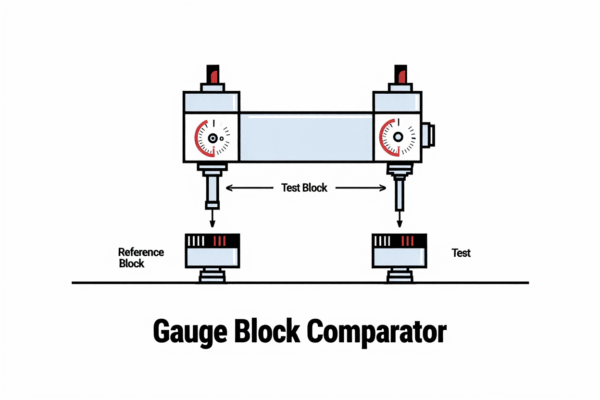
The operational logic of a gauge block comparator typically involves
• A reference standard gauge block of known length and traceability.
• Dual measuring heads or mirrors which contact (or optically reference) the ends of the gauge block under test.
• A measurement mechanism (mechanical, inductive, laser-interferometric) that determines the length of the test block relative to the reference.
• A read-out system (digital or analog) that reports the deviation: central length, maximum length, minimum length, parallelism (difference end-to-end), and sometimes difference in thickness or flatness. (scicron.co.th)
For example, in an automatic comparator the system may clamp the gauge block, load the standard, perform measurement, and output the result to PC software for documentation and traceability. (sumipol.com)
The key is that the comparator enables high repeatability and precision, often in the sub-micrometer range for high-end models.
Key Features & Technical Specifications
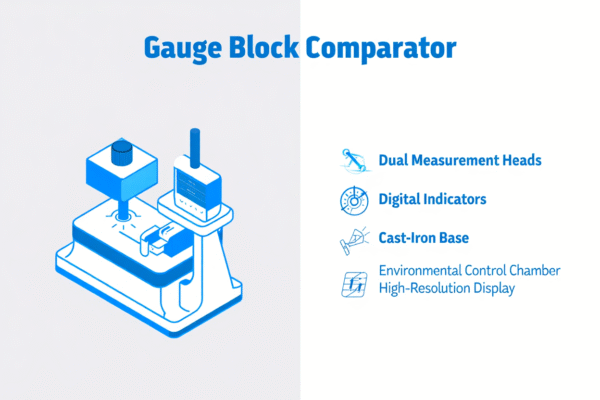
When evaluating a Gauge Block Comparator, here are common features and specs to consider
• Measuring Range: The minimum and maximum block lengths the unit can inspect (e.g., 0.1 mm to 250 mm). (sumipol.com)
• Resolution & Uncertainty: High-precision systems can achieve resolutions in the micrometer or sub-micrometer range (e.g., 0.001 µm) and uncertainties around ±0.01 µm under specified conditions. (scicron.co.th)
• Manual vs Automatic: Manual comparators require operator positioning; automatic systems handle loading, measurement and data output. (sumipol.com)
• Dual Gage Heads / Differential Head Design: Many models use dual heads so that comparisons can be made between two ends of a block or between test vs standard simultaneously. (mitutoyo.co.th)
• Data Output & PC Interface: For calibration labs the ability to export results, apply statistical process control (SPC) and integrate with lab management systems is a plus.
• Environmental Controls: Because precision gauge block measurement is highly sensitive to temperature, measuring force, cleanliness and mounting stability, many systems include cast-iron bases, protective enclosures, or thermal compensation. (scicron.co.th)
• Parallelism & Flatness Measurement: Some comparators provide measurement beyond length (e.g., flatness of the block faces, parallelism of ends) which are critical for high-grade gauge blocks.
Typical Applications & Use Cases

A Gauge Block Comparator finds use in several calibration and production contexts:
• Calibration Laboratories: For calibration of gauge block sets (e.g., grade 0, 1, 2). For example, a Thai accreditation lab uses such equipment to service gauge blocks. (nimt.or.th)
• Precision Manufacturing / Aerospace / Automotive: Where gauge blocks are used as reference lengths for micrometers, height gauges, CMMs, and the accuracy of those reference blocks is vital.
• Workshop Setting with In-house Metrology: Some manufacturers keep a comparator to verify their shop’s block sets to ensure traceability and reduce measurement drift.
Quality Assurance and Traceability: When your inspection tools depend on gauge blocks, and you need to audit or certify those blocks regularly, a comparator helps ensure chain-of-traceability.
In short: wherever gauge blocks serve as the base standard for downstream measurement, a comparator helps maintain the integrity of that standard.
How to Use a Gauge Block Comparator in Your Lab
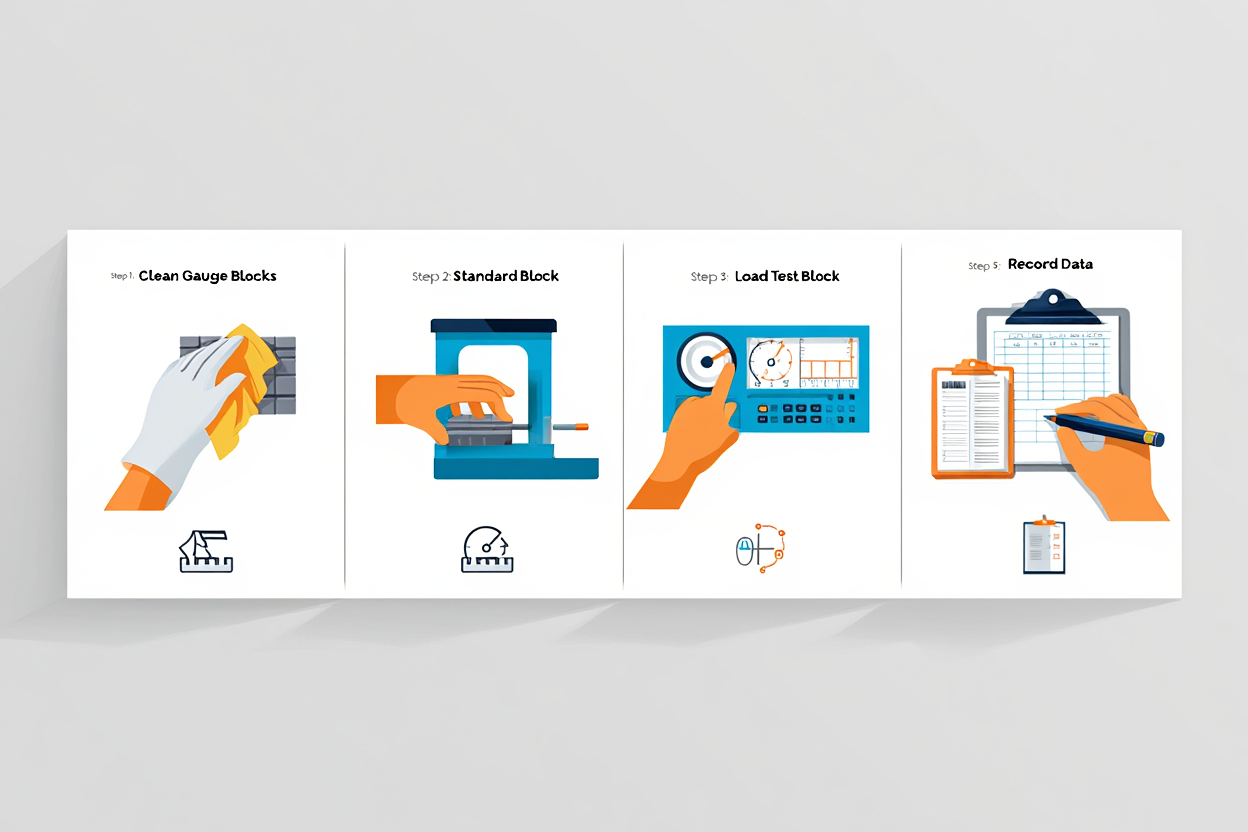
Here is a sequence of steps (generalized) for using a Gauge Block Comparator
1. Warm-up and Environment Check: Ensure machine has reached thermal equilibrium; the temperature should typically be 20 ± 0.5 °C for gauge block measurement.
2. Clean the Blocks: Both the test block and reference standard must be cleaned and wrung (if required) to remove oil, debris or corrosion.
3. Load the Reference Standard: Place the standard gauge block in the comparator’s reference position. Zero or set the comparator as per manual.
4. Load the Test Block: Place the block to be measured under the heads, ensuring correct seating and alignment.
5. Measurement: Initiate the comparator sequence (manual or automatic) to measure length, parallelism, maximum/minimum, etc.
6. Capture & Record Data: Use built-in software or export results for documentation. Many comparators provide tolerance judgments and flag out-of-spec blocks.
7. Interpret Results: If length deviation or parallelism exceeds your tolerance, mark or remove the block from service or send for repair/calibration.
8. Maintenance & Verification: Regularly verify the comparator itself with certified gauge blocks and maintain calibration.
By following standardized procedures and making sure environment, handling and measurement force are controlled, you minimize error and ensure reliability of your gauge blocks.
Selecting the Right Gauge Block Comparator
When your lab or shop is deciding on a comparator, consider the following criteria
• Range Needed: What is the maximum length of gauge blocks you intend to inspect? If you deal with long blocks (>250 mm) you’ll need a comparator with suitable range.
• Accuracy / Resolution Requirement: For high-grade blocks you might need sub-micron resolution; for workshop grade maybe ±0.5 µm is sufficient.
• Manual vs Automatic: Automatic comparators cost more but increase throughput and reduce operator error; if you calibrate many blocks, an automatic unit could pay off.
• Traceability & Data Handling: If you need data logging, statistical analysis, or integration into your Quality Management System (QMS), select a model with PC interface and output options.
• Budget & Service: Consider initial cost, calibration cost, and availability of service/parts locally. Also think about space and environmental control (vibration isolation, temperature control).
• Brand & Support: Brands like Mitutoyo have established comparator models (e.g., Series 565) used widely in calibration labs. (JSR GROUP)
Choosing the right model means balancing budget, throughput, accuracy and long-term serviceability.
Maintenance, Calibration & Best Practices
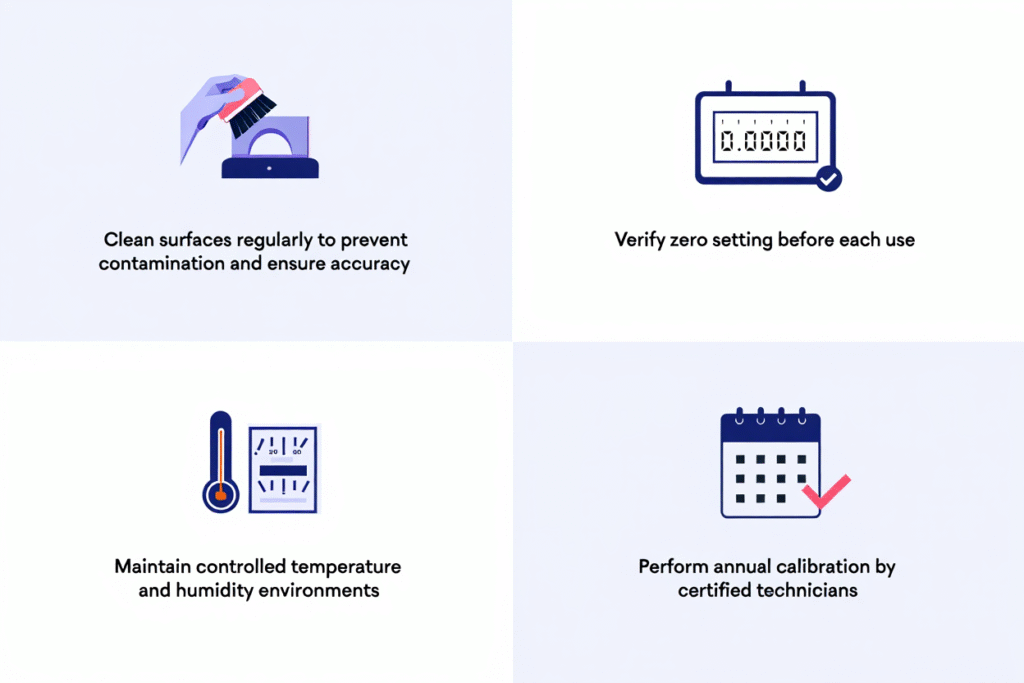
• Daily Cleanliness: After each use clean contact surfaces, heads and blocks. Remove debris, fingerprints and oil.
• Zero/Reference Check: At the start of each measurement session verify the reference standard and comparator zero.
• Calibration Interval: Follow your lab’s policy (often annually or semi-annually) to calibrate the comparator and its reference standards.
• Environmental Control: Maintain stable temperature, humidity, and vibration conditions. Even small thermal expansion will affect lengths at µm scale.
• Document History & Drift: Keep log of drift over time for each block set and comparator. Trend-analysis can warn of equipment or block wear.
• Operator Training: Ensure users know how to mount blocks, avoid measurement force bias, wring blocks properly and interpret results.
By applying best practices you ensure your gauge block comparator remains a reliable backbone of your metrology system.
Conclusion
A Gauge Block Comparator is a critical piece of equipment for any advanced metrology or calibration setup that relies on gauge blocks as reference standards. Whether your workflow is dedicated calibration lab work, precision manufacturing or in-house QA, the comparator ensures that gauge blocks themselves meet the standards of accuracy required. Investing in a suitable comparator and following proper procedures safeguards the integrity of your measurement chain and supports traceable, high-quality metrology.